Welcome to the online version of From the Politics Desk, a daily newsletter that brings you the NBC News Politics team’s latest reporting and analysis from the White House, Capitol Hill and the campaign trail.
In today’s edition, Steve Kornacki dives into the massive turnout in the Texas Democratic primary for Senate. Plus, Andrea Mitchell sifts through the Trump administration’s growing list of mixed messages on Iran.
Sign up to receive this newsletter in your inbox every weekday here.
— Adam Wollner
What Democrats’ sky-high turnout in the Texas primary does — and doesn’t — mean for November
Analysis by Steve Kornacki
Democrats in Texas are feeling enthusiastic about their voters’ enthusiasm — and for good reason.
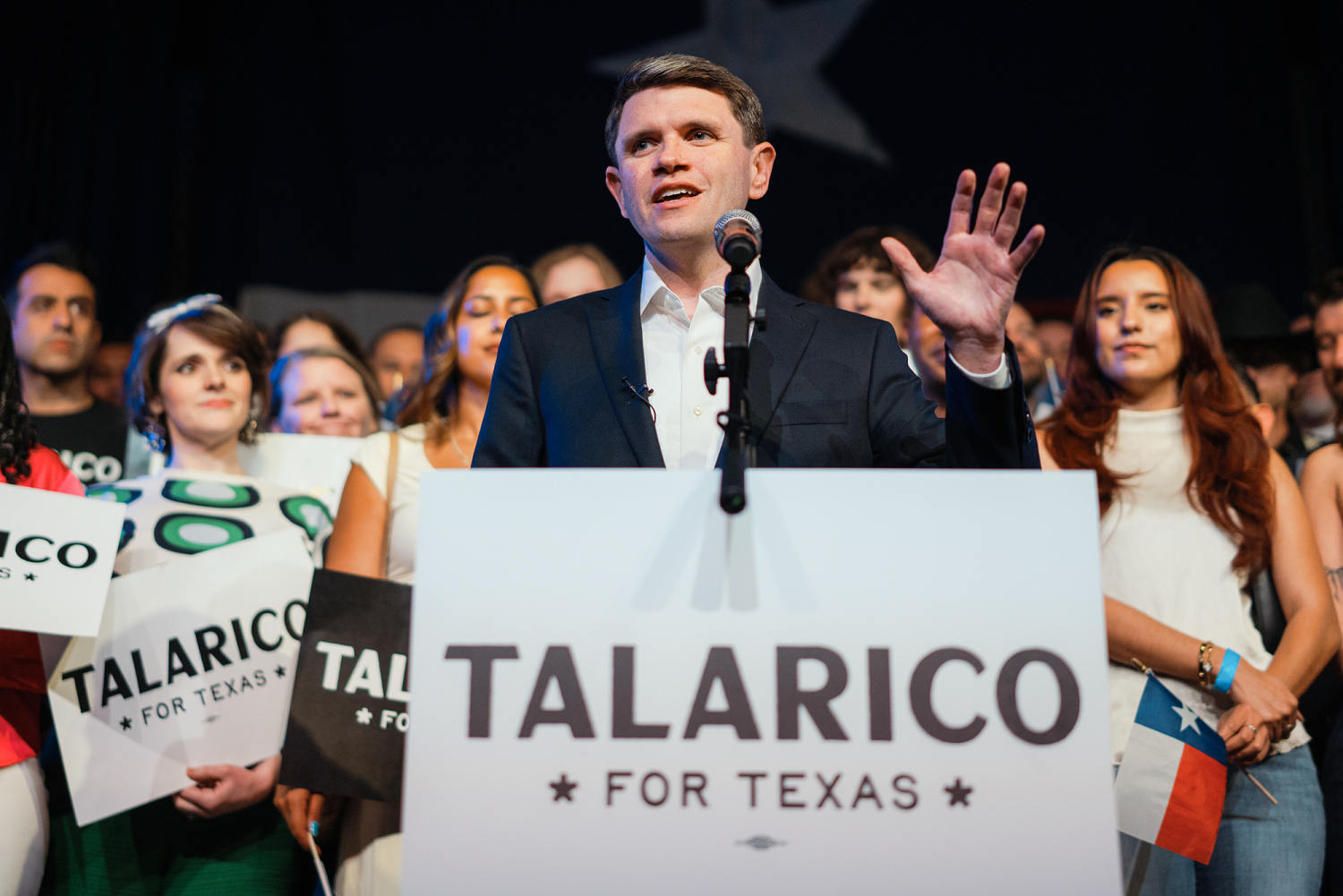
For the first time in a generation, it appears they have outpaced Republicans in turnout for a midterm primary in the state. It’s a significant achievement for a party that believes that in James Talarico and 2026, it has finally found the nominee and the moment to deliver a breakthrough victory in the traditional Republican stronghold.
But while Democrats are emerging from Tuesday’s primary with understandable optimism about Talarico’s chances of capturing a Senate seat, the results come with some cautionary notes, too.
Start with the numbers. With the final votes still being tabulated, more than 2.2 million ballots have been cast in the Democratic Senate primary featuring Talarico and Rep. Jasmine Crockett. That figure is more than twice as high as anything seen in a midterm primary for Texas Democrats this century. It’s also more than 100,000 votes higher than the current turnout level for the GOP contest.
What’s doubly impressive about the Democrats’ turnout level in the race is that it came even as Republicans were locked in an unusually competitive primary of their own, with Sen. John Cornyn facing challenges from Texas Attorney General Ken Paxton and Rep. Wesley Hunt. In a red state like Texas, one might assume that a high-stakes GOP contest would easily attract the most interest from voters, especially with the astronomical sums of money that were poured into it.
Clearly, Democratic-aligned voters are deeply — even historically — energized right now. What isn’t at all clear, though, is what this will portend for November.
Certainly, primary turnout doesn’t always correlate with general election triumph. For instance, in the 2008 presidential primary season, nearly 3 million voters took part in Texas’ hotly contested Democratic race between Barack Obama and Hillary Clinton, compared with barely 1 million in the GOP battle between John McCain and Mike Huckabee. But that November, Texas remained safely in the GOP column, with McCain beating Obama by 12 points in the state.
Democratic turnout in this year’s Texas Senate primary is also part of a much broader national trend that has accelerated since Trump’s return to the White House. Particularly among the economically upscale, college-educated voters who have become a bigger part of the party’s base, participation in elections is sky-high. These are voters who are repelled by Trump and intent on using any and every chance they have to register their views at the polls.
In primaries and special elections, this kind of energy imbalance can really show. But November will bring a much broader electorate, and in Texas, the Senate general election could conceivably attract 10 million voters. As impressive as their show of force was Tuesday, that will leave Democrats needing to win over about 3 million additional voters in a state that delivered a 14-point victory to Trump in 2024. As the Democratic nominee, Talarico will need to persuade voters, not just motivate them.
More from last night’s elections:
- President Donald Trump said he will “soon” endorse a candidate in the Texas Senate Republican primary now that Cornyn and Paxton are headed to a runoff. Trump also said that whoever he does not back should drop out of the race.
- Two more Democratic House incumbents were forced to runoffs in Texas: Reps. Al Green and Christian Menefee will go head-to-head in the 18th District on May 26, while Rep. Julie Johnson and former Rep. Colin Allred will face off in the 33rd District.
- After another victory in Arkansas, Democrats have now flipped control of nine state legislative seats in special elections since Trump took office last year. In that same time, Republicans have not flipped a single state seat controlled by Democrats.
The Trump administration’s mixed messages on the Iran war
Analysis by Andrea Mitchell
Top administration officials are trying to coordinate their explanations for President Donald Trump’s decision to launch combat operations against Iran.
Their justification has ranged from eliminating a nuclear threat Trump claimed to have “obliterated” last June, to removing Iran’s growing supply of conventional missiles and drones, to pre-empting an imminent strike from Tehran. Secretary of State Marco Rubio added a new twist, saying it was to pre-empt Iran’s expected retaliation for an anticipated Israeli strike that had not yet happened. Twenty-four hours later, the president clarified that Israel had not forced his hand.
Now, NBC News has reported that one factor dictating the timing of the strikes was a call from Israel’s Prime Minister Benjamin Netanyahu last week, telling Trump that Israeli intelligence had learned Ayatollah Ali Khamenei and his closest advisers would all be together on Feb. 28.
First reported by Axios, and today acknowledged by White House press secretary Karoline Leavitt, U.S. intelligence quickly confirmed the planned meeting, creating an opportunity to remove the regime’s leaders — another motive for the war. Trump made his hopes to remove Iran’s regime explicit in his video announcing the strike, when he urged the country’s people to rise and take control of their future.
In that video, Trump also justified striking Iran by tracing 47 years of Iran’s hostility toward America, starting with Iran’s revolution, its takeover of the U.S. embassy in Tehran, the hostage-taking of U.S. diplomats for 444 days, and a litany of terror plots over decades — including the bombing of the Marine barracks in Beirut, Lebanon, in 1983, killing 241 personnel.
For Trump, Iran’s terrorism is also personal: the president and Defense Secretary Pete Hegseth have both referred this week to two Iranian plots to assassinate Trump. Hegseth said the leader of one of those plots was killed in a strike Tuesday.
“Iran tried to kill President Trump and President Trump got the last laugh,” Hegseth said this morning.
At the Council on Foreign Relations today, Elbridge Colby, the Pentagon’s undersecretary for policy, described the war’s objectives as dismantling Iran’s missiles, one-way attack drones and naval forces. Two administration officials yesterday briefed reporters on the failed diplomatic talks, explaining they had focused on eliminating Iran’s nuclear threat — its stockpile of enriched uranium and its insistence on the right to enrich more nuclear fuel, supposedly for medical isotopes.
They described Iran’s response as “games, tricks, stall tactics.” They said they limited their negotiations to the nuclear issue because regional players were handling the missile issue and the attempts to eliminate Iran’s support for proxy terror groups. No one has identified who those alleged regional players were, nor where or when any alleged talks on those issues might have been held.
The decision to forgo preparing the American people for the onset of combat operations has been made by previous presidents. Trump brushed over Iran only briefly in his State of the Union address last week, including an incorrect claim that Iran would “soon” have long-range missiles that could reach the U.S. The Defense Intelligence Agency has said that will take another 10 years.
But the decision not to prepare the public has left thousands of U.S. citizens in the Middle East unable to evacuate when the war began. Now the White House and State Department are arguing that there were warnings, but most weren’t issued until this week. By then, the airspace was already closed to commercial flights because of a full-blown war.
More on the Iran war:
NBC News poll: Majority of voters disapproves of how Trump has handled Iran, by Ben Kamisar
Senate blocks resolution that would have restricted Trump’s war in Iran, by Scott Wong and Frank Thorp V
Iran strikes risk more voter frustration on the economy with rising gas prices, by Jonathan Allen
Vance’s anti-war posture collides with his more hawkish views on Iran, by Henry J. Gomez
Trump officials consider arming Kurdish opposition against Iran’s regime, by Katherine Doyle, Dan De Luce, Courtney Kube and Monica Alba
🗞️ Today’s other top stories
- 📝 Epstein saga: The GOP-led House Oversight Committee voted to subpoena Attorney General Pam Bondi for testimony on the department’s handling of records related to Jeffrey Epstein. Read more →
- 🚫 The nays have it: The House voted to scuttle an effort by Rep. Nancy Mace, R-S.C., to shed more light on sexual misconduct allegations against members of Congress. Read more →
- 🪑 In the hot seat: Two of Labor Secretary Lori Chavez-DeRemer‘s top aides have resigned amid an ongoing probe of possible misconduct by officials in the department. Read more →
That’s all From the Politics Desk for now. Today’s newsletter was compiled by Adam Wollner.
If you have feedback — likes or dislikes — email us at politicsnewsletter@nbcuni.com
And if you’re a fan, please share with everyone and anyone. They can sign up here.