When the Oscar-winning documentary “No Other Land” captivated Hollywood with its portrayal of the Israeli-Palestinian conflict, The Daily Wire sent me to the West Bank to see the story up close.
The film, which won the 2025 Academy Award for Best Documentary Feature, follows Palestinian activist Basel Adra and portrays the residents of Masafer Yatta as victims of what the filmmakers describe as forced displacement by Israel. During his Oscar acceptance speech, Adra accused Israel of carrying out ethnic cleansing.
“‘No Other Land’ reflects the harsh reality that we have been enduring for decades and still resist as we call on the world to take serious actions to stop the injustice and to stop the ethnic cleansing of the Palestinian people,” Adra said.
But is that true? I set out to Masafer Yatta in Judea and Samaria, also known as the West Bank, to investigate these claims, which went largely unchallenged on Hollywood’s biggest stage.
In “No Other Lie,” I revisit the story told in Adra’s film by traveling to the same villages and speaking with Israeli officials, Arab residents, Jewish farmers, and policy experts. According to those interviewed, the history of the area — and the dispute over the land — is far more complex than the film suggests.
WATCH ‘NO OTHER LIE’ NOW ON THE DAILY WIRE
I spoke with Naomi Kahn, director of international affairs at the Israeli policy organization Regavim, who explained that the land featured in the documentary has a long and complicated history stretching back to the Ottoman Empire, when it was mostly uninhabited public land.
According to Kahn, the area later became strategically important for the Israeli military after Israel signed a peace treaty in 1979 with Egypt and gave up the Sinai Peninsula, which had previously been used for military training exercises.
“They looked for areas that were strategically important to hold on to, but also were empty and useless,” Kahn said. “And they identified this entire band of desert cliffs that were uninhabited.”
Basel Adra and Yuval Abraham (Photo by Monica Schipper/Getty Images)
Kahn said the area was eventually designated as an Israel Defense Forces training zone. She also addressed claims that Palestinians are unable to build homes in the area, saying construction is regulated through permits.
“Everyone can build where it’s legal,” she said. “If you build without a permit, you can’t build.”
She pointed to the territorial divisions established under the Oslo Accords, which gave the Palestinian Authority control over large portions of the West Bank in Areas A and B, while Area C remains under Israeli jurisdiction.
“Almost 70% of the territory already under Palestinian Authority jurisdiction is empty,” Kahn claimed. “Instead of building there, they’re building here.”
In “No Other Land,” one resident claims his family has lived in the Masafer Yatta area since the 1830s. But historical aerial imagery and findings from Israeli courts show that the hills of Masafer Yatta had no permanent villages for decades, with aerial photographs of the area dating back to 1945.
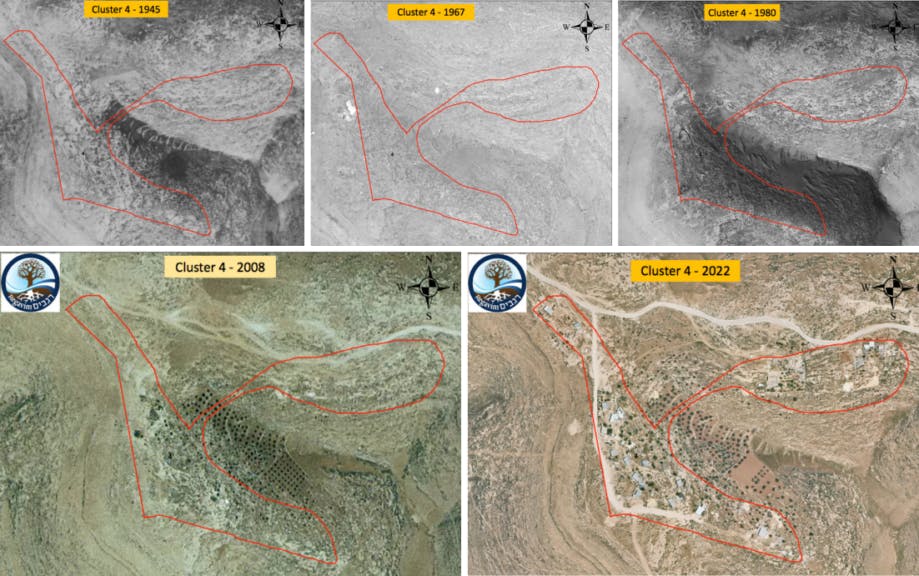
The Israeli High Court case over the land dispute, which lasted over two decades, ultimately ruled that the petitioners failed to prove permanent residence in the area before it was designated a military firing zone in 1980. The ruling also noted that several of the residents involved in the case maintained permanent homes in the nearby Palestinian city of Yatta.
As my crew and I traveled deeper into the desert terrain, we encountered foreign activists who had traveled to the area and who locals say often provoke confrontations between Jews and Arabs.
“They come all the time when it’s nice outside,” local Jewish farmer Bezalel Talia said. “From England, from Australia, South Africa, America.”
I met several activists who acknowledged traveling to the area from the United States and Europe.
Residents told me they believe the presence of international activists armed with cameras is meant to artificially create incidents that can push a one-sided narrative in the media.
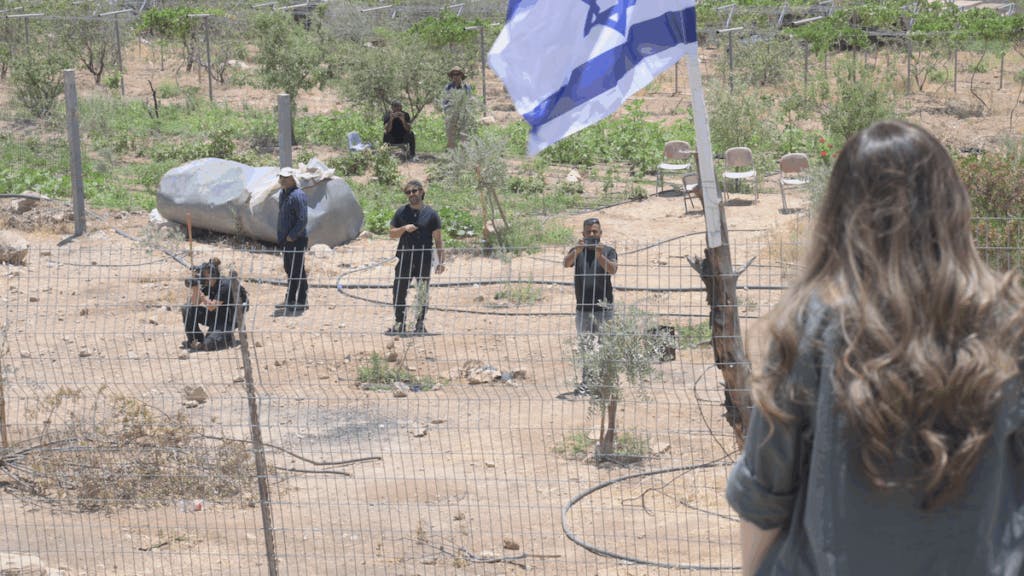
(The Daily Wire/Yisroel Teitelbaum)
“They’re not really fighting the fight that you know,” Talia said. “You have Arabs that only live here because the Palestinian government told them. So they live there in the cave and sometimes Europeans, Basel and his Oscar friends just [come] to have a nice picture, Like Instagram models.”
U.S. Ambassador to Israel Mike Huckabee discussed the historical and biblical significance of Judea and Samaria. Huckabee said the region has been central to Jewish history for thousands of years, noting that Judea was the heart of the ancient Jewish kingdom and the seat of the Jewish capital under King David more than 3,000 years ago.
“The consistency has always been that there has been a Jewish presence and a Jewish connection to the land, historically and biblically,” he said.
When asked why such a small piece of land receives so much global attention, Huckabee argued that the focus is often less about geography and more about opposition to the existence of a Jewish state.
“I don’t know that they care about the land,” Huckabee said. “They are offended that there is a Jewish tradition, that there is a Jewish people, and that there is a Jewish homeland.”
I also visited the ancient Jewish city of Susya, where archaeological remains highlight the long history of Jewish life in the region.
Standing inside a 1,600-year-old synagogue, Kahn said the site demonstrates the deep historical connection between Jews and Judea.
“This is a synagogue, a Jewish place of worship, 1,600 years old,” Kahn said. “This is essentially proof positive of the Jewish presence in Judea for thousands of years.”

U.S. Ambassador to Israel Mike Huckabee (The Daily Wire/Yisroel Teitelbaum)
On the final day of filming, I traveled to Hebron — the first capital of King David more than 3,000 years ago — where tensions between Jewish and Palestinian communities remain high.
There, I spoke with Yishai Fleischer, the international spokesperson for the Jewish community of Hebron, who addressed the frequent accusations of settler violence.
“There is settler violence because if you push Jews around, they’re going to push back. This is the Middle East,” he said. “But it is far, far, far less than has been reported and is being touted as the truth; it’s not the truth.”
A recent report by Regavim also challenged the widely reported narrative of widespread settler violence, arguing that the campaign accusing Jewish residents of escalating violence relies on misleading data and politically motivated sources.
Analyzing 10 years of incident reports compiled by the United Nations’ Office for the Coordination of Humanitarian Affairs, the report found that roughly 98% of the incidents categorized as “settler violence” did not involve Jewish civilians at all, but were instead clashes with Israeli security forces or other unrelated incidents.
I also asked Caroline Glick, an advisor to Israeli Prime Minister Benjamin Netanyahu, about the Academy of Motion Picture Arts and Sciences’ decision to award “No Other Land” the Academy Award for Best Documentary.
Glick said the film presents a misleading narrative about Israel.
“This sort of giving the most prestigious awards in Hollywood to people who just created a completely fictitious narrative about something deeply important to billions of people throughout the world,” Glick said.
The fight over Masafer Yatta is not only about land or law, but also about narrative. While “No Other Land” won Hollywood’s highest honor, “No Other Lie” asks whether the Academy will look more carefully at the stories it chooses to reward.